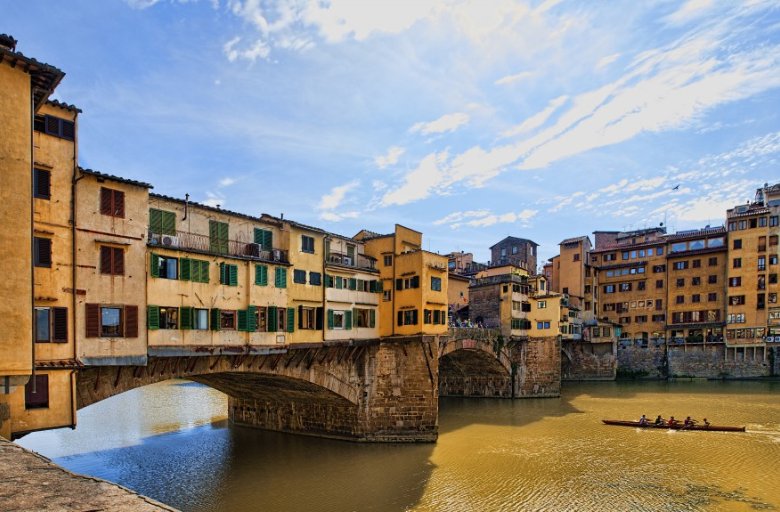
The Ponte Vecchio is one of Florence’s landmarks and probably the most photographed bridge in the city. But did you know that Florence has many more bridges over the Arno River and that each has its own history? Here’s a bit of information about each of the bridges that crosses the Arno in the historic center of Florence, and two on the outskirts.
Bridges in the historic center of Florence
All of the bridges in Florence except the ponte vecchio were bombed during the Nazi retreat in August 1944, and reconstructed either in modern form or to resemble earlier bridges. From east to west these are:
Ponte San Niccolo

The early 19th century Ponte San Niccolo was suspended metal!
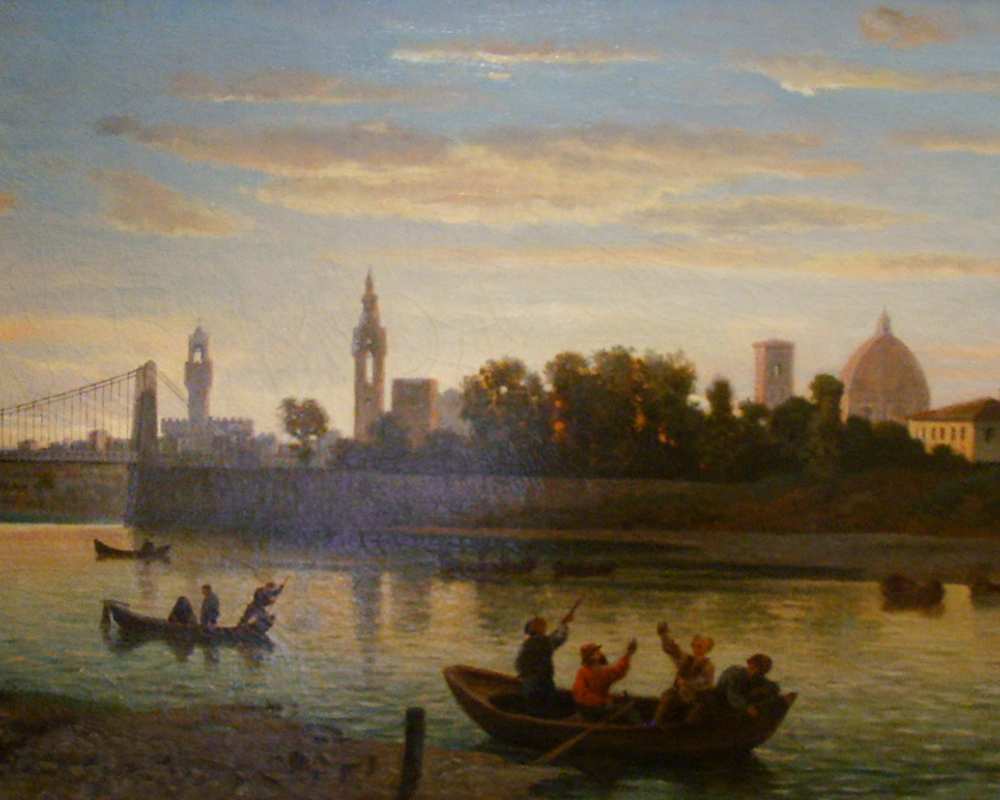
Now it’s a single-arched bridge in reinforced cement, the only one in fact not to be composed of multiple arches. Can you imagine what the riverline would have looked like had its early 19th century French structure remained? The painting to your left shows the suspended metal bridge (named for Ferdinand III de’ Medici) with the ponte vecchio behind it. After the war, the city chose more traditional building materials for all the bridges in order to be harmonious with each other and with the ponte vecchio.
Ponte alle Grazie
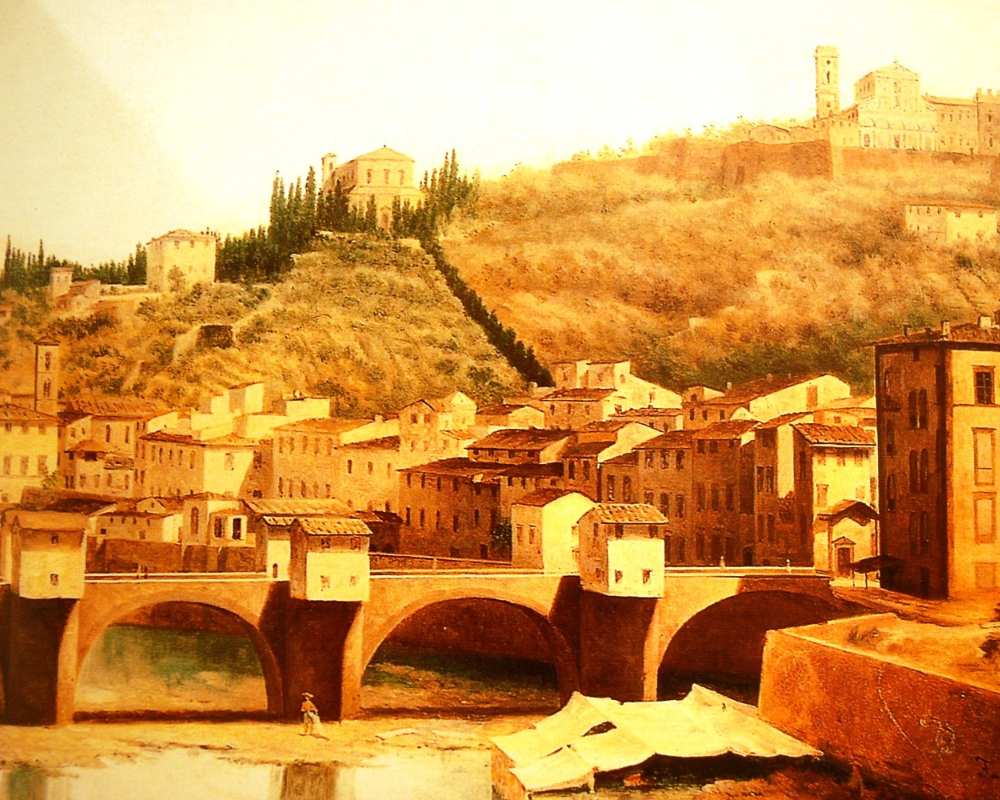
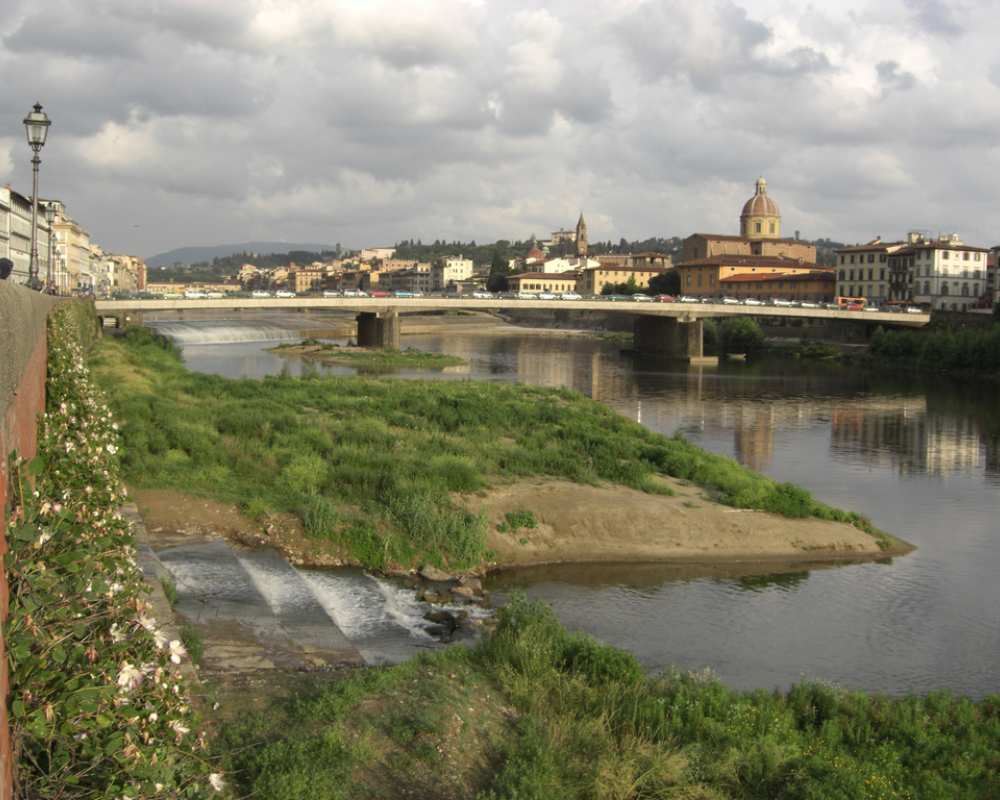
This rather ugly bridge from the 1950s (by Michelucci, author of the beautiful Highway Church) replaces an earlier structure, bombed in the second world war. A 19th-century renovation had already removed the bridge’s medieval characteristics as it had resembled the Ponte Vecchio in that it had houses, shops, and even chapels on it.
Ponte Vecchio
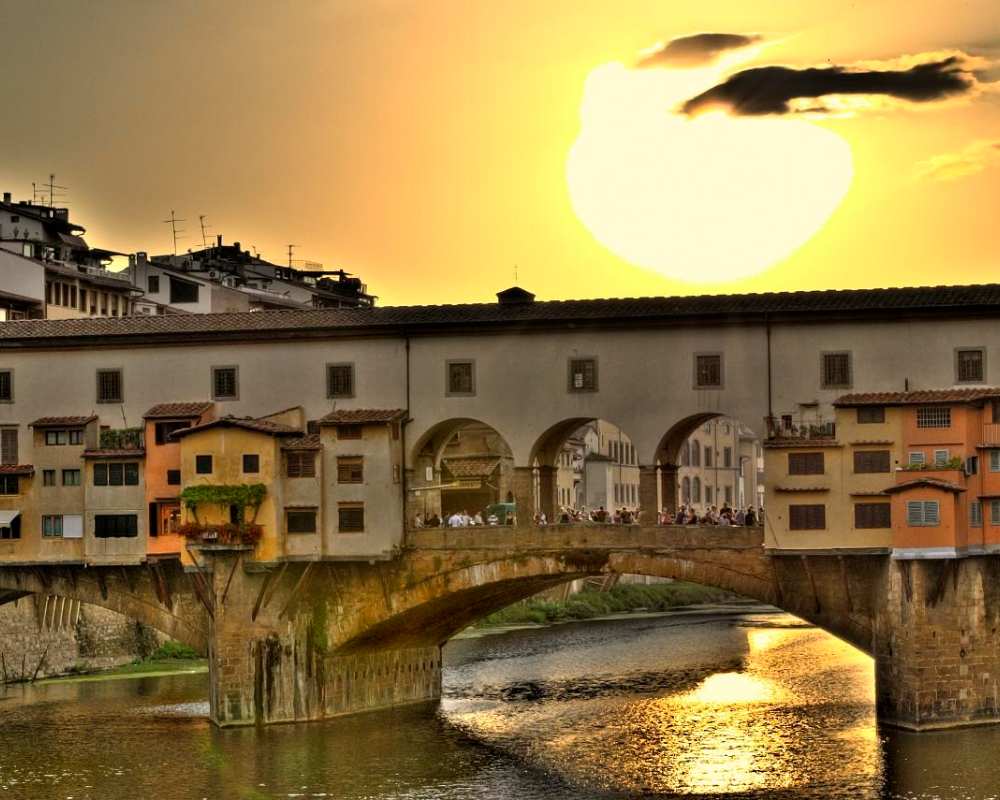
The most famous bridge of them all was built at the narrowest part of the Arno. It’s distinguished as being the only remaining bridge to have houses and shops on it. In part this is because something important was built on top of those: the Vasari Corridor. This secret passageway built by Vasari for Duke Cosimo I de’ Medici in 1565 links the Palazzo Vecchio to the Pitti Palace. In 1593, the jewelry stores that tourists so love were brought to the bridge on command of Ferdinando, the Medici heir who thought that the previous tenants – butchers – smelled too bad in his corridor.
During WWII, the treasures of the Uffizi gallery were stored in the Corridor. Hitler had been on a tour of it at the start of the war, and perhaps because of this, the Ponte Vecchio was the only bridge spared bombing during the German retreat of August 1944.
Of the bridges mentioned in this post, it’s the only one that is pedestrian-only.
Ponte Santa Trinita

Ponte Santa Trinita
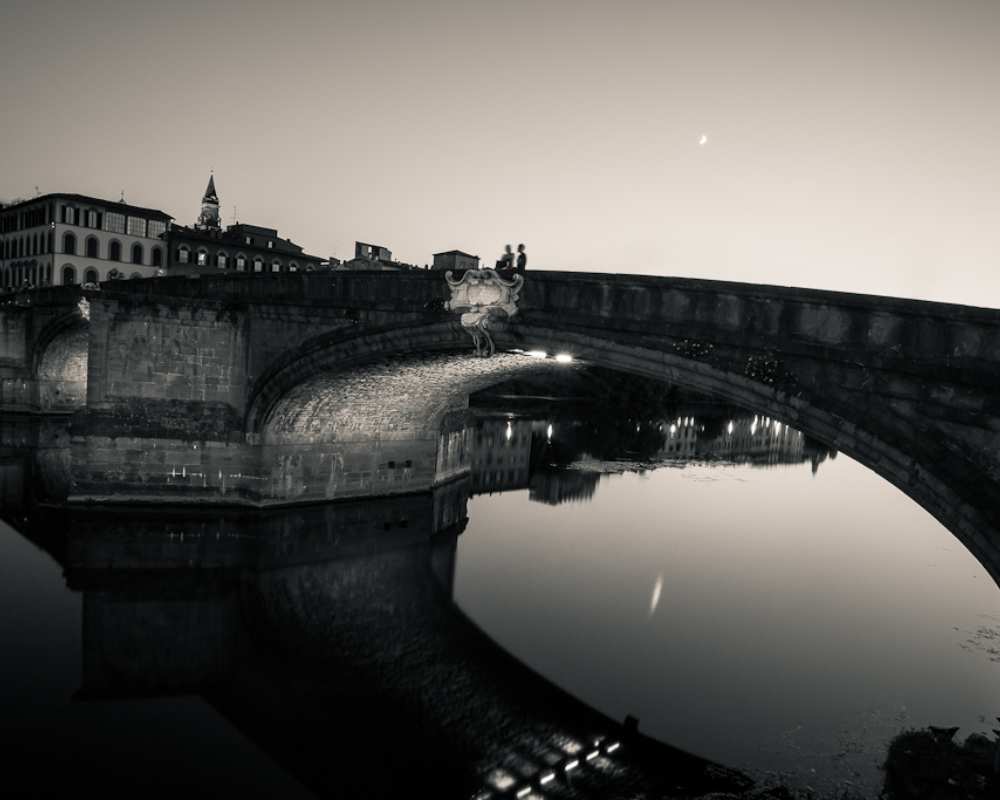
Named for the church of Santa Trinita nearby, this is probably the third oldest bridge in Florence – although it was rebuilt many times. The way we see it now is the way it was reconstructed after nazi bombing; the design is by Amannati with the patronage of Cosimo de’ Medici and possibly the help of Michelangelo. The elliptical form of the arches has been paraleled to the curve of the top of the tombs in the Medici Chapels. At the center of each arch is a white marble cartouche, and at either end of the bridge there are two allegorical statues representing the four seasons from 1608. After the bombing of 1944, the statues were fished out of the Arno, but the head of Spring has never been found. [See this photo of the pre-war bridge.]
Ponte alla Carraia

Ponte alla Carraia
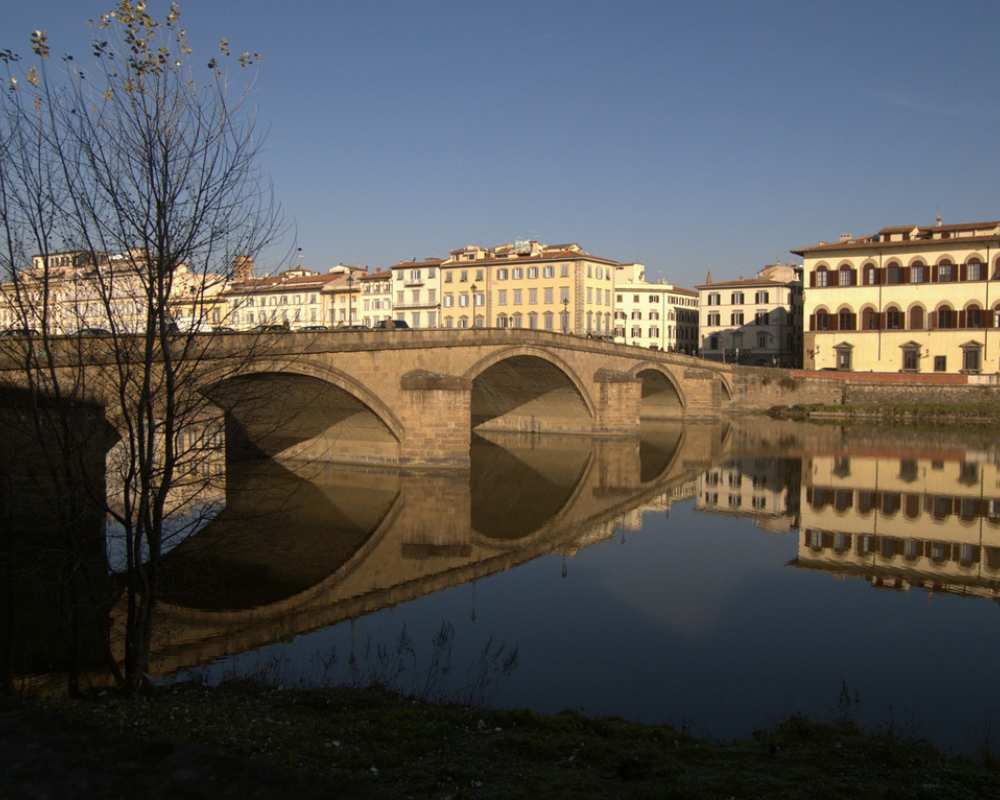
This bridge was the second to be built in Florence, so after “Ponte Vecchio” they called it “Ponte Nuovo”. That was back in the early 13th century; its newer name reflects a wider later version that allowed carts to pass. Like any old structure, it suffered over time and was rebuilt in a few different versions. The aesthetics of the current version are thanks to Amannati with the patronage of the Medici in the 1560s. It was destroyed by the retreating nazi army at the end of WWII and rebuilt with care as close as possible to its previous state.
Its graceful arches reflect in the water on a calm day and I think it is a nice reflection of 16th-century aesthetics. Apparently, though, when the bridge was re-opened in 1952, citizens criticized its particularly heightened curve, nicknaming it Ponte Gobbo (hunchback).
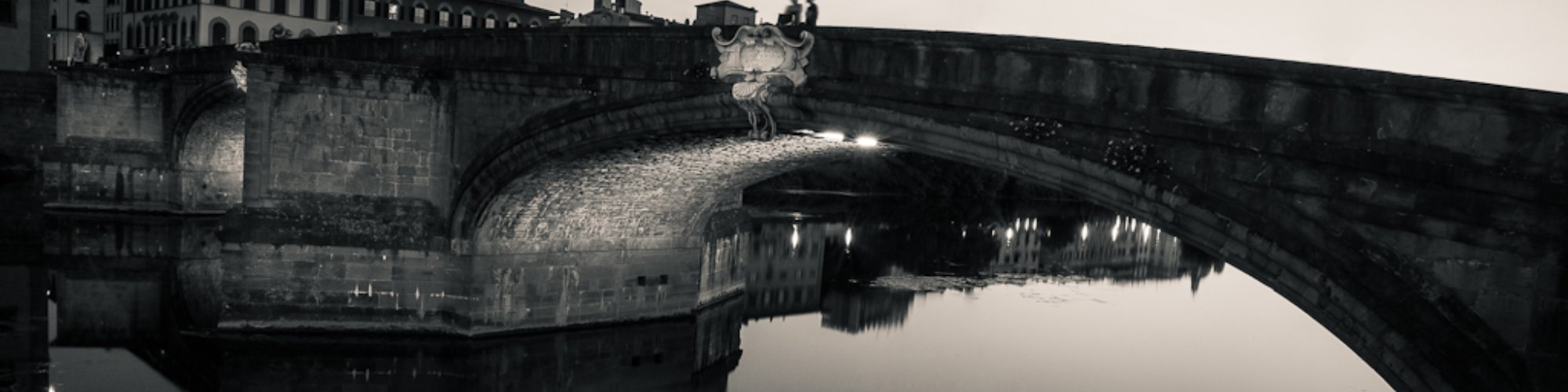
For just a few days in January 2011, this bridge was home to a new resident – a guerrilla statue installed by night by the artist CLET.
Ponte Amerigo Vespucci
Named for the great explorer, this modern bridge (1950s) isn’t all that exciting to look at. It connects the historical center to the Oltrarno area of San Frediano. Perhaps the most particular thing about it is that cars are allowed to park on it.
Bridges Outside Florence historical center
At the level of the ring roads (viali), you get the trafficked Ponte alla Vittoria, and then there are no further ways to cross the arno until you get all the way out to the Ponte all’Indiano.
Ponte all’Indiano

A view from under the Ponte all'Indiano: photo cultura.toscana.it
This connects Florence airport area (Peretola) to the suburb Isolotto. Built from 1972-78 it’s very different from all the other bridges in Florence, since it didn’t really have to harmonize with the old stone style of previous bridges. Traffic in opposite directions travel on separate 2-lane roads and there is a pedestrian passage below. It’s also particularly long because the bridge proper is extended by an elevated road for a total of 3 kilometers (you don’t want to get stuck on this if you aren’t sure, cuz you end up so far out of your way!) .
In case you’re wondering if there were American Indians involved in this bridge’s name, according to wikipedia, there weren’t. Rather, it refers to the proximity of the mausoleum of an Indian prince, Rajaram Chuttraputti di Kolhapur who died young (age 21) during a European trip in 1870. [source: Region of Tuscany 20th century architecture database entry.]
Ponte di Varlungo
This bridge is the exit of the A1 highway at Firenze Sud and it’s interesting for the way that it’s constructed on various levels to give access to both the highway (above) and a residential area below/nearby. The late 70s cement design is not particularly beautiful but it sure is complex.
There are a few other bridges that I’ve skipped, as well as the many bridges that cross the arno outside the limits of the city itself.