Gerhard Richter, Familie Schmidt, 1964. Photo: Elke Walford © Sammlung Sohst in der Hamburger Kunsthalle You enter the Strozzina contemporary gallery by going down a set of stairs from the..."
Gerhard Richter and the Disappearance of the Image...
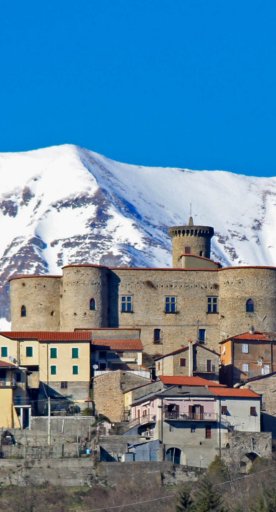
1San Gimignano is contemporary art: spring 2010 exh...
2A look into the Invisible with De Chirico
3Posted in Renaissance, Spotlight
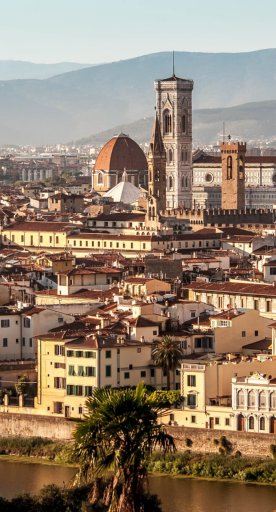
Itinerary: Finding Michelangelo in Florence
Michelangelo was born in 1475 to a Florentine family while they were temporarily residing near Arezzo (Caprese), and he was sent out to a wetnurse near Settignano whose husband was a marble-cutter. He told Vasari that he drank in a love of stonecutters’ tools with his wet-nurses’s milk.
He was apprenticed at age 13 to the Ghirlandaio painting workshop in Florence but he didn’t stay long… From 1490-92 he was welcomed into the Medici Palace where he began training as a sculptor under Bertoldo di Giovanni, and where he created some of his earliest works which can be seen at the Casa Buonarroti in Florence – notably the Madonna of the Steps and the Battle of the Lapiths and the Centaurs. With the death of Lorenzo in 1472 he returned to his paternal home in the Santa Croce area of Florence. Although he worked for many years in Rome for Pope Julius II, with whom he had a tumultuous relationship, he kept strong ties to Florence – to his own family and to the Medici family - leaving Florence with a wealth of works by Michelangelo that you can explore by following this itinerary.
Here is the Michelangelo itinerary on Google Maps!
Read MorePosted in Contemporary Art, Exhibits
Gerhard Richter and the Disappearance of the Image in Contemporary Art

Gerhard Richter, Familie Schmidt, 1964. Photo: Elke Walford © Sammlung Sohst in der Hamburger Kunsthalle
You enter the Strozzina contemporary gallery by going down a set of stairs from the main courtyard of the Renaissance Palazzo Strozzi and you find yourself in a different world, one that is refreshing in the context of Florence’s often staid cultural offering. I went to see Gerhard Richter and the Disappearance of the Image in Contemporary Art on a Thursday night, when the gallery is FREE from 6pm and open late, until 11pm! There was a lecture taking place in the gallery, and it was quite full of young people and 30-something couples like us – I dragged my husband, a colleague, and the colleague’s girlfriend there, of course. It was a nice evening, it cost nothing at all, and we had a few good laughs. Maybe we should have considered more seriously the themes treated by the artists, which are certainly important, but I think there’s nothing wrong with cracking a few jokes while discussing paintings and trying to relate them to our own experience or knowledge.
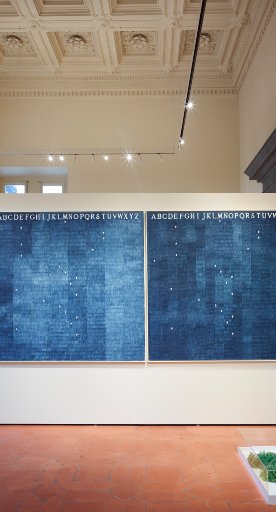
The exhibition space at the Strozzina morphs for every show; the order of rooms this time is different than for Manipulating Reality, and we decided amongst ourselves that the layout is significant. You enter first into the largest room, in which you learn about Gerhard Richter from a wall text and by looking at some of his most representative paintings, like the blurred Schmidt Family Portrait of 1964 and the black and white Decke of 1988, not to mention the image that is used on the exhibitions posters, Portrait of Liz Kertelge of 1966. The wall text also addresses the other works by Richter that are placed in rooms at either extremity of the exhibit. In this way, Richter is at the center of the show – with mini-solo-exhibits by seven contemporary artists radiating out from him – but Richter also parenthetically closes the story told in this space.
Read MorePosted in Art & Technology
Google and National Library of Florence sign digital book agreement
Google and the Italian Ministry of Cultural Heritage reach agreement to digitize works from Italian libraries including Florence’s BNCF.
Google and the Italian Ministry of Cultural Heritage (MiBAC) announced on March 10th a partnership to scan up to a million out-of-copyright Italian books from the National Libraries at Rome and Florence (BNCF, Biblioteca Nazionale Centrale di Firenze), making them available to readers around the world. This is an agreement that has been in the works for some time; the director of the BNCF mentioned it at the conference on the digitalization of museums, libraries and archives that I attended in January.
Some of the unique collections from these libraries will become easily accessible in digital format to anyone with an Internet connection. This is the first collaboration between Google Books and a government’s ministry of culture, a partnership that Google hopes will result in the preservation and dissemination of important works of Italian history and literature. The Italian books scanned will also enrich Google Books’ multi-lingual collection and make Italian language works more widely available to the public. Amongst the books planned for digitalization are the works of Machiavelli, Dante, Petrarca, Leopardi and Manzoni.
Read MorePosted in Contemporary Art, Exhibits
San Gimignano is contemporary art: spring 2010 exhibits at Galleria Continua
Until May 15 2010, five solo shows by important, international contemporary artists’ at Galleria Continua in San Gimignano are, in a way, a bit of a memento mori – a reminder that we are all human and we will all die sooner or later. Chen Zhen’s earth-covered objects, Berlinde de Bruyckere’s reflections on death and Pancrazzi’s obsession with time are hardly cheery. Sassolino, too, is concerned with time, but lightens things up with his odd machines, while Solakov encourages us to reconsider everything around us.
Galleria Continua is one of the most innovative private galleries in Tuscany in my opinion, and it is located in the charming town of San Gimignano (SI), where you can also enjoy the medieval towers and the early renaissance frescoes in the Collegiata (duomo), and then recover from art-overload with a plate of steaming risotto with San Gimignano’s famed DOP saffron.
Read MorePosted in Exhibits, General Arts
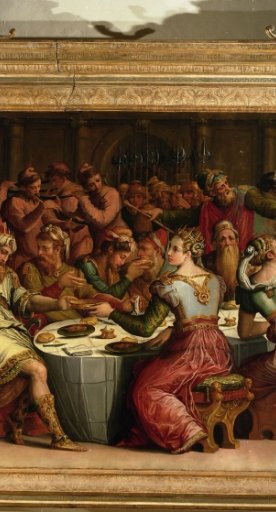
A look into the Invisible with De Chirico
The exhibit De Chirico, Max Ernst, Magritte, Balthus: A Look into the Invisible at Palazzo Strozzi (Florence, Feb. 26 to July 18 2010) is both a learning experience and one that inspires reflection. Focusing on Giorgio de Chirico, it considers the vast influence he had on 20th-century art, the period in which artists discovered how to paint internal emotional expression. The exhibit opens with De Chirico’s enigmas, the origins of metaphysical painting. Working somewhat chronologically, we then discover his recurring visual motifs such as the mannequin, the bird, the tower, the empty piazza. We see these themes taken up by Carlo Carrà (a creepy copyist) and Max Ernst (who gets it and makes it his own), and an expansion of the concept by the smooth René Magritte. And we meet a few artists of whom I’ve never heard, including Alberto Savinio – Giorgio’s brother.
Read MorePosted in General Arts
Announcing Slow Art Day in Florence: April 17 2010
April 17 2010 is International Slow Art day. 46 cities around the world are participating in this growing sensation, and Florence is the only city in Italy! TuscanyArts (that’s me) is hosting this event on Saturday April 17 2010 at the Church of Santa Croce in Florence, followed by an aperitivo at nearby Brac contemporary art bookstore/cafe.
What is SlowArt?
I think Slow Art can be best defined as an occasion to look at art… slowly – and then to discuss it – casually. The idea behind SlowArt, which was begun by Phil Terry and Reading Odyssey last summer in New York, is to get people to spend a bit longer looking at single works of art, as research shows that people spend as little as 8 seconds looking at each work in a museum.
Read MorePosted in General Arts
Accessible Florence: Museums, Churches, and public spaces
17/02/2010: The city of Florence, in collaboration with the association Cittadinanze – Turismo senza Barriere, has just updated the pamphlet “Luoghi d’arte a Firenze per tutti” – Art areas in Florence for everyone – which provides a list of the city’s museums, churches, and public spaces of historic interest and the degree of accessibility that each has. The superintendant of tourism says “This guide has been developed with not only the otherwise-abled in mind, but also for other users such as the aged or mothers with strollers.”
Posted in Contemporary Art, General Arts
Tuscany and China just got closer
Two major pieces of news this week bring Tuscany and China a whole lot closer: Tuscan contemporary art will represent all of Italy at Expo Shanghai 2010, while the Uffizi is sending a major traveling exhibition to five cities in China this year.
Tuscany to represent Italy at Expo Shanghai 2010
The exhibit “Italian Genius Now – Home Sweet Home“, curated by Marco Bazzini, director of Centro Pecci in Prato, has been chosen to represent contemporary art in Italy at Expo Shanghai 2010, an event that is expected to attract 70 million visitors. This is a real coup for Tuscany and for the Centro Pecci which is currently undergoing an important expansion plan to accomodate its permanent collection.
Read MorePosted in General Arts
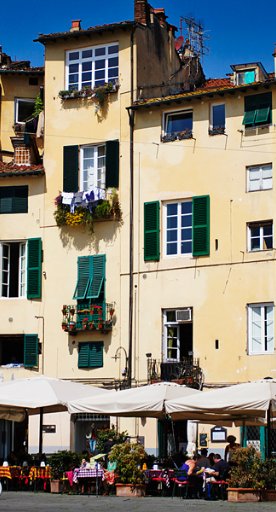
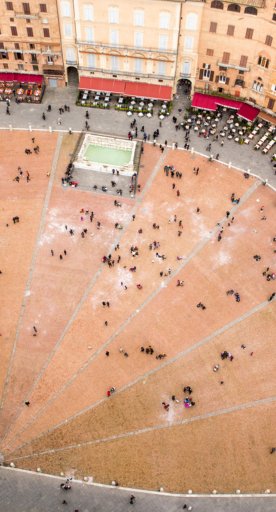
The “piazza”: definition, history, and the most beautiful examples in Tuscany
Piazza Savonarola in Florence - a meeting place for my friends. Photo: wikimedia commons
I have always loved the way my Italian friends set up a meeting to go out for the evening. “Ci si vede in piazza!” – which means “we’ll see each other in the piazza” and go from there. Let’s talk about the piazza – what it means, what it was historically, and what some of the most beautiful examples in Tuscany are.
Translation and definition of “piazza”
The Italian word piazza (plural: piazze) is generally translated as square in English, though this is a misnomer since it implies a shape in which very few piazze are constructed.
The word piazza comes from the Greek platea (the ground floor of the auditorium) from platys (wide space or opening). With time this developed to mean more specifically the piazza in the city (”agorà in polis”), which both for the Greeks and Romans, and for Renaissance Italians, was the central pulse of the city. That is, it was not just a physical space but a meaningful one. The piazza is the political, commercial, and religious heart of the ancient city. In the middle ages, especially in larger cities like Florence, these functions were separated amongst various piazze, so that Florence’s political center is Piazza della Signoria and the religious center is Piazza Duomo; the economic center has always been Piazza della Repubblica which was the site of the ancient Roman forum and medieval market. With the Renaissance’s desire to return to the ideals of Ancient Rome in many ways, including in city planning, there was some effort to reunite these functions in just one piazza.
Your favourite Piazza in Italy – Google Map!
I asked the fans of TuscanyArts on facebook what their favourite piazza is and why. I was surprised at the variety and number of responses I got! I thought it’d be nice to make a google map of your favourite piazze (even if they are not in Tuscany) – you can also add to this map, put a placemarker on it and a description or even a photo!
Read MorePosted in Contemporary Art
Prato looks to the future of art and the city
Reporting live from the BIT in Milan! news fresh from the Museo Pecci press conference in the Tuscany booth – the museum is doubling in size and will display its permanent collection:
Architect Maurice Nio declares that he is pleased to be designing and building a contemporary art museum for Prato because “we must look to the future and for new possibilities.” The Dutch firm NIO architecten has designed a new wing – or ring, really – that will embrace the old purpose-built structure from the end of the 1980s. With the expanded space, Museo Pecci in Prato becomes a true regional center for contemporary art, and the only space of this kind in Tuscany.
Read More